Showing posts with label Alan Dean Foster. Show all posts

Thursday, November 12, 2015

The Alan Dean Foster interviews

I've refrained from posting the unexpurgated transcripts from my Making of STAR WARS interviews because my separation contract from LFL returned the transcribed content rights of said interviews to LFL in exchange for residuals on any earning derived from said materials. There was one clause which allowed me to use my work, and that was if the material was a necessity in establishing my professional credentials.

I haven't wanted to push the envelope by publishing the interviews, but there are segments in this first Alan Dean Foster interview done on July 27, 1976, which are really important both in terms of showing how my relationship with George and Star Wars went beyond being publicist, and also as a prelude to my write up on the STAR WARS HOLIDAY SPECIAL.

There are 3 audio tape interviews with ADF. This first is 45 pages long. As I've decided to upload in it's full, raw form. I might run out of steam before I finish. The pertinent points I need to show to you becomes fairly clear early on. I mean, I got tired cleaning up the formatting, typos, etc. at the half way mark, and it's taken me several hours. Is there really any point dumping on you guys and gals the unexpurgated contents?

In all fairness, the salient points of the interview can be found in Star Wars Insider.


Pt 1: INTERVIEW - ALAN DEAN FOSTER, TAPE 1 - 7/27/76
PARTICIPANTS: GEORGE LUCAS, ALAN DEAN FOSTER, CHARLES LIPPINCOTT


GL: I'm not completely finished going through it again. It's all down about, page 200 so I've got about 50 pages to go. Most of the things are very little, words, and things like that.

ADF: Stuff like that can always be changed in galleys.

GL: Yea. I told Judy Lynn that -- The only thing I told her was that D-2, which in the film we call R-2. So I just changed all the D-2s to R-2s.

ADF: So you did that already?

GL: I told her. I don't know... I'm going through and I'm trying to do it. It's one of those fairly typical things, it keeps slipping over. We all do it.

ADF: When the galleys come, and I proof the galleys, I can do that

GL: Yea. We can all just sort of check through it.

ADF: That was something I didn't know about and I had no way to catch it..

GL: Most everything I've got is real teeny. You know, it's a word here and there. The one thing that I came....

ADF: The reason I did that is it was Threepios

GL: Yes, I know. It's one of those very hard things to describe why that happens. But it did. It's hard enough to get them organized, anyway, and if some of the people can at least read the novel and remember that R-2 is R-2, it's going to be a little tricky in the movie, 'cause we keep referring to him all the time. I'm afraid some people won't realize what it is. Ah, most of the stuff is... You had one thing, too, Charley.

CML: Well, I had several things.

GL: You had one thing about the fighter.

CML: Yes. Page 4... that first ship when we talk about her and the ship, it's at the bottom of the page, third line from the bottom, It's described as a fighter.

ADF: Yes. Originally, I had it down as a freighter.

GL: Well, it's bigger than a fighter. It's a big ship.

ADF: But would it be a destroyer? A cruiser?

GL: It's been a problem in the script. I called it a blockade runner but it's a... maybe we could call it a frigate. How's that?

ADF: Well, it's funny you mentioned blockade runner. I was thinking like the German Q ships. They look like freighters but they are war ships.

GL: Well, this is like a -- it's like in the 747 class. When you think of fighter, you think of the two-man.

ADF: Well, you could get around it completely and just call it the rebel ship.

GL: Fine.

CML: I don't think so. I think you ought to have a description. I think you're at a point where you call it the rebel ship at the beginning of the first page, and you don't describe the size of the ship, because people are going to be into it right away, . . . You're calling things rebel ships at the other point, we know there's a larger ship, right?

GL: We could call it a cruiser. A star-cruiser.

CML: Yes.

GL: Something that denotes that it's a substantial size, but isn't like a freighter. It's got class. It's more of a slick ship.

ADF: If it isn't a freighter, than it's a war ship. I could call it blockade runner. It's not running any blockades, though, so let's just call it a cruiser.

GL: Ok, that's fine. Wonderful.

CML: There's something Alan and I talked about... that I hadn't talked to you about too much. But the whole idea of the dark lords. Do you see them as many dark lords and he's only one still?

GL: Ah... the way we've got it now is that he's the only one left. But that's what you had, right?

ADF: OK. He's the only one left that we know about which means that we can bring in other lords if we want to.

GL: I think that's all right.

CML: Yea. because the only reference you made was on Page 13, "Fear followed the footsteps of all the dark lords."

GL: I don't think I really caught that.

CML: Third sentence from the top.

GL: Oh. Well, why don't we just go through it page by page? Most of the stuff is so little. The only thing I've got is actual size. Because it’s the first thing. It's this prologue. The only thing... I think we started off on the wrong foot. I was going to try to just write something up, but I didn't get to it -- yet. So maybe we can discuss it. Rather than do a explanation of the -- it's the excerpt from the Journal of the Whills. Rather than saying the Emperor was... and all of that stuff... some of it was, to me, it's the logic of it was different from what I was going for. I noticed in the script, you sort of used just a little bit but it wasn't enough to make any difference. 'Cause I had it where what happened was like -- well, vaguely, like Nazi Germany. Or like Richard Nixon. It's like a Republic and Senate, and at one point, the President decided he would rather be called the Emperor than the President, and it sort of passed. And as people began to realize it, a lot of the senators began to be bought off and were intimidated and pretty soon there wasn't any Senate anymore. There was still a Senate, but it wasn't as strong and pretty soon the Emperor was becoming a Fuhrer. And nobody could stop him. It was like when they had a minor revolution when he branded all the Jedi as traitors. Had them electrocuted to get rid of them, and he began to get more fascist, using cruder techniques. Pretty soon the Republic was no longer a republic. And then he decided not to call it the Republic anymore. He decided to call it the New Empire.


Pt 2, INTERVIEW - ALAN DEAN FOSTER, TAPE 1 - 7/27/76
PARTICIPANTS: GEORGE LUCAS, ALAN DEAN FOSTER, CHARLES LIPPINCOTT


This is the important relevant quote in this second section -- "I was thinking of how to start the film in a knoll-like hobbit hole kind of thing. And you go in and there's a Wookie family. Mama Wookie, Papa Wookie, and Baby Wookie. You know where I'm coming at... (laughs) ... And Daddy Wookie was going to sit down the Baby Wookie on his knee and tell, him the story."

Remind you of anything? The STAR WARS HOLIDAY SPECIAL, which, when I asked folks what they wanted me to write about, came up as the most favored topic... There are a lot of underground rivers which lead to the STAR WARS HOLIDAY SPECIAL. As you can see from this quote, it was an idea George had since 1976.


ADF: This is the present Emperor?

GL: Yes. It just happened within Ben's lifetime. He was the last of what remains of the Jedi which was the Big Betrayal when Luke's father was killed. It all happened very quickly. Now the Emperor is quickly trying to consolidate and come down on -- he does get rid of the Senate completely, he lets the Imperial Governors take over. So it's a point when Empire's really coming down, and a few little mice are off in the corner, causing trouble. But he's making official what has been going on for the last -- say, four years. He's been saying... it's sort of the last run of the Republic instead.

ADF: No problem. In the absence of that, I couldn't make this up.

GL ; No, I realize that. The other thing is, I wanted to take it out of the spacey science-fiction thing, and turn it more into 'Once upon a time, in faraway land' rather than, in a different galaxy. That happens more during the time of William Shakespeare.... something that gives it sort of -- I don't know how to approach it. And we can approach it in several different ways... We can either go into a...

CML: You mean the quality of the Conan Doyle quote?

GL: No, not really. Maybe it's...

ADF: What you want is -- is, you want the fantasy. Give it that tone -- of much more of the once

GL: I want more of a fairy tale quality.

ADF: OK. Then I'll rewrite this three pages.

GL: I had an idea -- as a joke -- which usually ends up being my best ideas — I don't know whether we dare try it. It might be interesting. I thought of doing it in the movie, actually, and then I chickened out. But I was thinking of how to start the film in a knoll-like hobbit hole kind of thing. And you go in and there's a Wookiee family. Mama Wookiee, Papa Wookiee, and Baby Wookiee. You know where I'm coming at... (laughs) ... And Daddy Wookiee was going to sit down the Baby Wookiee on his knee and tell, him the story. That isn't quite it, but it is more in the level of -- rather than a hard thing -- you know, much more of a -- I don't know. The idea sort of intrigued me a lot and you open with a big old journal, a leather-bound... "Well, now, Uncle Chewbacca brought this back from his adventures, just before he died, and .. whatever... What do you think of something like that?

ADF: I think it's a lovely idea but it's sort of distracting.

GL: For the rest of the movie.

ADF: For the rest of the movie. People would start... particularly if you made people -- in any way -- your hero would automatically become Chewbacca. It would be a fascinating way of telling the story, from the standpoint of a non-human. But unfortunately, it would be a shock.

GL: Well, the original idea. -- The way the whole movie has gone, -- and it still is there -- is to tell it from the point of view of the robot. They are the ones who get told. In the process of the movie, I sort of fell in love with the Wookiee. They are so big and fuzzy and so on. But it's the tone of that. The big, fuzzy storybook quality rather than the hard-edged steel sort of science fiction... The interesting thing about doing something like that is... I don't know. It's only -- it's not really relevant to the rest of the world, but it's a thing that would bring Chewie out. Right now, the story is more or less told from the robot's point of view, but obviously Luke and Hans come forward and it really becomes Luke's point of view. The story is more interior on him and he's the one who feels and does the stuff. Well, I don't know, it was just something I was thinking of.

ADF: I'll do anything you want, George. But I really think that

CML: I think you would lose a sense of what you've done in the film. And the style.... it would be working against the style of the film.

ADF: I'm just worried that everyone will begin to wonder about Chewbacca and the little family, and what will happen in the future.

CML: If your film was really more Disneyesque, then you've got Uncle Remus and the Tales of Briar Rabbit right there.

GL: The film really is very Disneyesque.

CML: I know you can say that but from what I saw, I don't think

GL: It's much more than you can possibly imagine. Believe me.

CML: But it ain't science fiction

GL: It was also depending more on that kind of... But maybe we can put that kind of quality in without actually doing that. It's just a matter of... I do want to establish that it takes place in another galaxy, far away from us and in another time. A time that could have been -- maybe somewhere, something, maybe it was in that Calender article -- it takes place in a time maybe in the past, maybe in the future, but it was written sort of interestingly, the way he phrased it. You know, something that establishes that this is a story that just -- I want to try to get the thing out of the science fiction thing and more into a fantasy kind of thing, cause I think more than anything else, that's where our trouble is going to be. No matter what we do, no matter what we write, it's still going to be a science fiction thing. But if we try to take the edge off the thing, I think it will help us...

ADF: I'll try something. Look, if you don't like it, I can rewrite it. We're only talking about a couple of pages here. At the very worst, you can always start on page four.

GL: Yea. That's what I thought.

ADF: What about the quote from?

GL: I think that's all right. It's a little . . .

CML: This is where he got it. It's right out of that material.

GL: Did you write this or did Brian write this?

CML: I wrote it and then Brian rewrote it a little bit. So then I rewrote it again.

GL: It isn't really that interesting. I thought it was nice to cut out?

ADF: Well, since we're eliminating all of this history about a succession of Emperors, and this is the first Emperor — an offstage character — who suddenly makes himself Emperor, President or whatever he makes himself, then I can't have (garbled) Empress...

GL: Yea. No, that was another thing. I was ... I don't want... The idea is that she doesn't become an Empress. I have to sort of work that whole thing out. She becomes, maybe a Senator in the New Republic. I know she is a Senator, but she's been ex-communicated. The Princess is, that her father is the King of Alderaan which — He's an elected ruler but he's also part of the royal family of elected, and everyone's very fond of her. It's like the Kennedy sort of thing... If it is not in the future, we are in some galactic past. Or some alternative, extra-temporal present. Well, anyway, it's something just to set off the whole thing. Say, this is a story that took place in another time and another place.

ADF: Just enough to divorce it from the present.

GL: Yeah, from the present. and to give it a little bit of... you come away with this quality... you forget about trying to figure out why the laser swords can't possibly work at four feet and all that stuff.

ADF: The main question I've got to ask is -- why are the laser swords four feet long, and how they work. That's why I didn't call them laser swords, I call them lifesavers.

GL: Yea. They are called lightsabers, they aren't called laser swords, ever... I noticed that for Judy Lynn, the fact that she had written laser swords, I told her to change it to lifesavers. But that was the only thing I caught.

CML: Yes, that was probably better.. . .

GL: Yes, it is lifesaver, it doesn't work... whatever. Anyway, that is the main thing.. If you want to go into some of the background about how -- which may be valuable -- what it is more or less the way I described it -- which is the way it was originally thought of -- as it's like Nixon or Hitler, how it took over. They just started corroding the system to the point where they were functioning, and the system wasn't.

ADF: It's a narration from the Thief of Bagdad.

GL: Yea.

ADF: There was an evil lord and so forth and so on and

GL: Pretty soon the Senate found they didn't have any powers anymore... The thing of it is they used to think the galaxy was so big, the only way they could really control the galaxy -- just on a simpleminded level -- was just to keep contact through the Senate. The only reason the Senate stayed as long as it has — assume that the Emperor got elected chairman, then the chairman decided that first of all the Jedi were out to plot the overthrow of the Empire and he had them all killed, and then he decided that he would call himself the Emperor and say that we don't need to call it the Republic and we change the name of the Empire, cause it's stronger. Then he starts to circumvent the election system. The only reason he's let the Senate stay as long as he did was because he needs the bureaucracy to keep things running. But in its place, he puts in the Imperial Governors to sort of control various systems. So once they got situated, and became powerful then he -- as he's just done in the middle of the movie, really -- he eliminates the Senate and lets the Governors take over. But it's so big that the Governors, being like him -- cruel and ambitious men, too -- it's like Nazi Germany, everyone's out for themselves. And they all care for their own little departments, and the Emperor is up there as the ultimate power but Goebbels has got his own little army over here and he doesn't even know it.


Pt 3, INTERVIEW - ALAN DEAN FOSTER, TAPE 1 - 7/27/76
PARTICIPANTS: GEORGE LUCAS, ALAN DEAN FOSTER,
CHARLES LIPPINCOTT


If I was more organized, I'd upload jpgs of the book covers I have in my collection, but think correcting and cleaning up the interview wore me out. Time for a nap... YAY!!!


ADF: I will try to make some political setup without getting technical about it.

GL: And it's the same thing as the Haldeman-Erlichman and Jaeger.... Everyone's got their own little thing. They've circumvented all the laws and all the honest things and they're just running roughshod without anybody knowing it yet. Once he declared that there was an Empire, a group of systems decided they weren't very happy with it. So they're revolting in a very quiet underground way. Nobody really knew about them and then the Rebels started attacking the Imperial things and just built this thing and that's why the Princess is really a Senator rather than a Princess.

ADF: Everything is fine in the book, as far as that goes.

GL: Essentially, that's how the script was laid out originally. So it all sort of matches. But... so it's the same thing with Darth Vader, which is described also... The reason I left him... He started out... there were a lot of Dark Lords and I sort of pared them down to where he was the Disciple as I described. And he just went to the Dark Side of the Force and used that to betray all of the other ones, to kill them and he's the only one left. And he is essentially working as an agent of the Force. Which he sort of got in there really well. And you say, who knows what his intentions are?

ADF: Well, that's sort of because... The whole thing I liked about Darth Vader was that Tarkin thinks that he's using Darth Vader and Vader... And there's that one sequence where Vader stands there and contemplates... because you always have... It's like there's really a big shark out there. We've seen the shark but now there's a really big one out there that no one knows anything about. A really monstrous inhuman evil that nobody knows anything about. Above and beyond the more mundane evils.

GL: I like that a lot. I like that. because it's really The Force. It's a struggle of The Force. It's like Lord of the Rings. There's the good and the bad. And The Force that exists around everything. And if the bad gets control, they'll have control of everything and it will really have control and it'll be dark times and evil people and distorted by The Force and it is essentially.... it's like using Vader as the son of the devil. He is the Antichrist. He is the one who1s come to spread The Force , the evil side of The Force among -- out across the galaxies. Whereas we have been in a time where there are lots of agents of good. And the good was very strong and that's what his thing is. He's really an agent of The Force. Which has nothing to do with the Empire. The Empire is just a means of beginning to transfer the evil. His whole thing is just to bring chaos to the structure of the entire galaxy.

ADF: That's the whole thing. We never know. And I hope I never want to know. We will always keep people wondering what's behind Vader.

GL: Right.

ADF: Is Vader the end of the chain or is there something else?

GL: But I think we can use that -- especially in going on. We can say... we can begin to develop the idea that he is what he's working at-- not really what he's working at -- but I think that's the direction that he was... He's always been sort of the evil thing in The Force but as I got into it more, I realized that he is really the devil and your basic force which is good and evil... which Ben is the agent of good and Vader is the agent of evil.

ADF: There's all kind of things that can be done with Kenobi. There are lots of possibilities... Big brother kind of stuff where slavery is freedom... all kinds of stuff. That will always be Vader's argument.

GL: Well, it's just bringing in the supernatural end of it. Vader being the agent of that side, and Luke — since Ben's gone — being the agent of the other side. And there, so it becomes in the end... so that Luke and Vader are really the two agents of this larger force field.

ADF: When we got through all this, I was going to ask you a couple of questions about the sequel.

GL: Well, let's go through this. Alright, we know -- on that, that is essentially the only thing — major thing. Now on page one or four.

ADF: Page four.

GL: Yea. I had one general comment which I don't know how this works out or who does it. . . Were the chapters... I was a little confused about how they were going to lay the book out. I noticed on some books, they put four spaces on the sequence changes, are they going to do that?

ADF: Yea. I do that when I -- quadruple spacing -- that is what they do in the book.

GL: Cause there's a lot of .... like when we shift from one sequence to another

ADF: Within a chapter?

GL: Within a chapter... I think we ought to space it.

ADF: The whole purpose is -- when I started, when I wrote my first book, I had the chapters in it. Ballantine was the editor at the time and he said, "People like chapters. It gives them a place to stop for dinner.

GL: People do like that.

ADF: And that's not necessarily. People could go fifty pages in one continuous sequence, and then have eighteen different sequences, jumping all around... which should all properly be divided in eighteen different chapters. But what I do is put a chapter every twenty pages which seems to be a convenient length, every 2500 words and then I use those other — with a certain amount of variations. In other words, if there is a natural break on page 23, then I break there and use the quadruple spacing for the rest of my natural breaks. But no, in the layout of the book, they will break (garbled).

GL: Yea. The one thing I noticed in the beginning... let me make a note of it... it's in the first chapter, there's a lot of cutting back and forth. I thought we might be able to lift one of the -- I think it's the Luke section -- and maybe lift the first Luke section and put it with the second one, so that we get a little more robots and then a little more Luke, so that it doesn't jump around quite as much as it does in the movie. I think it would make it easier to follow.

ADF: That's always the problem in converting the script, because you can jump around a lot more in film.

GL: I think there's a place in the beginning where we could... That's the only other general thing. Now, one thing I have here is.... I guess... "First of all nothing could exist on such a planet, least of all humans." I changed it from man to humans. I only use that in the interest of women's lib.

ADF: I think you’re overreacting.

GL: No, I don’t care. I mean it’s... I am aware of that stuff now so whenever I see that stuff, it sort of stands out in my mind.

ADF: But of course, this being a different galaxy and....

GL: Now, the only other thing, page 5. There is something I’m fairly concerned about here which was I didn't feel that we understood clearly the robots. "To look at them one would suppose the tall humanoids -- Threepio, to me, that reads as though he were human or he's like... If somewhere

ADF: That's... just make it the tall humanoid machine. Or the tall humanoid robot, Threepio...

GL: Humanoid-like machine

CML: Well, how did you interpret the sequence in the bar? With Han Solo in the cantina? When that girl was sitting on his lap and he described her as a humanoid?

GL: I thought she was a kind of android type creature, some kind of robotish android.

ADF: Just make it human-like

GL: Yea. Human-like machine. And was the master and the stubby tripedal robot -- If we put robot in there... At that point, I'd like to hit it fairly hard... So we sort of -- without any doubt know exactly that they're robots. No problem... On page 6, also in that line, "Threepio turned his smooth, human-like head" instead of 'human head.' In this chapter thing, I thought on 10 when we make the first shift from one place to another, I don't know whether this should be a chapter heading or take the sequence and....

ADF: You're right. It's not quadruple spaced there and it should have been.

GL: It's a real change of thought and if you run it together.

ADF: Probably the other's like that too.


TAPE CHANGE

Saturday, November 7, 2015

Alan Dean Foster postcard

Postcard from Alan Dean Foster Dec 10, 76. ADF's going to be at some conventions and wants SW materials. Says the people are responsible. meaning we'll get the art back. Although George Lucas' name is on the Star Wars novelization, you can see from this postcard that ADF wasn't told to keep his authorship a secret.


Tuesday, March 31, 2015

MARVEL STAR WARS COMICS PART 2

After the meeting with Stan Lee, Ed Shukin and Roy Thomas, I returned to LA. Marc Pevers and the lawyers at Fox worked out the deal with Marvel which included 6 comics, the first 5 of which were royalty free for the first 100,000 issues, with royalties thereafter. Starting on the 6th, STAR WARS would be licensed by Lucasfilm and 20th Century Fox to Marvel Comics. The deal was the first two issues had to be out before STAR WARS was released, with the 3rd being out the week of the film's release, May 25, 1977. There after, the comics would come out monthly.

Back in LA, I contacted Shel Dorf and arranged for Roy Thomas, Howard Chaykin and I to be put on the 1976 Comic Con schedule, which, that year, was scheduled for July 25-27 in San Diego. We would fly Howard into LA, but Roy would be in LA as he was planning on moving to LA. At Comic Con, we would release a poster by Chaykin to promote the film and comic book. Comic-con was 5 months away. There was lots of other work which had to be done. George and Gary had returned to Los Angeles to finish the film. There was tying up the featurette interviews and preliminary work on marketing and publicity. Alan Dean Foster was working on his novelization. The deal for ADF's novelization was it had to be in bookstores 6 months before the opening of the film, or in Dec., 1977. Following the Toy Fair, there was a lot of post-Toy Fair business which had to be wrapped up, including concluding licensing deals. Then getting ready for Comic Con.

Once Howard had finished the artwork for the Chaykin poster, I took it to the printers and had it printed up. I had the ILM art department work on getting materials for the booth ready. Below you'll see a sketch Joe Johnston did up of the Comic Con booth concept, courtesy of Pete Vilmur. Like all concepts, the booth didn't turn out like the concept. Certainly wasn't as pretty and colorful. Joe Johnston also did the sign for selling the poster. Then the day finally arrived. I went to pick up Howard from the airport, and we were off for our start of the Comic Con adventure.

Much has been made of our presentation at Comic Con because it was the start of a Hollywood tradition of presenting movies at Comic Con. Prior to STAR WARS, movies didn't get announced at comic conventions, nor were comic books done in advance of a movie's release. Our first presentation had that very same Hollywood glamor which transformed Comic Con from the tiny acorn it was into such a huge, crowd-bashing, sold out event. A glamor, I might add, that even comic book folks are seduced by, as evidenced by the number of times comic book folk like to recount their brief touches with that Hollywood glow.


Comic Con was July 21–25, 1976. Roy had moved to Los Angeles and we flew Howard into Los Angeles for the Comic Con. After the convention, on July 27, 1976, I met with HOWARD CHAYKIN, ROY THOMAS, GEORGE LUCAS, and MARCIA LUCAS to discuss the MARVEL STAR WARS COMIC BOOK in my office on the Universal lot, which was George and Gary's old AMERICAN GRAFFITI office.

George: Well, I think this is just primarily to meet you. I'm a big fan of yours.

Howard:
Thank you. It's nice to be accepted.

George: Got a lot of your stuff. Especially your Cody Starbuck. About half-way through this I discovered Cody Starbuck and it's great. It's fun. It's got a lot of, umm, I like the style.

Howard: [nodding head in agreement] I could do with it whatever I wanted to do.

George: If you like comics, you like comics.

Howard: Yeah, I like comics. I'm looking forward to getting started on this thing. And after I finish this thing, I've got my baby -- the thing I've wanted to do since I was seventeen. It's an adaptation of Chip Delaney's NOVA thing I've been playing with for years, and I probably don't give a damn (garbled).[1]

[NOTE: Howard is referring to his 1978 book, Empire, by Samuel R. Delany, which he illustrated with original paintings that was published by Byron Preiss. Preiss pioneered a short lived Fiction Illustrated book format which was kind of a graphic novel crossover. At the bottom of this post, I've footnoted the different Illustrated Fiction books we are talking about.]

Howard: Byron Preiss [1], the Fiction Illustrated publisher with those paperbacks.

Charlie: [to George] You haven't seen those yet, have you? They came out while you were away.

George: Yeah, I don't think so.

Howard: They're paperback size, digest size. Steranko's done one, Steve Fabian one science fiction alternative...

Charlie: [interrupting] STARFAWN [2]

Howard: Real flabby, real average. Did you think much of it?

Charlie: [shaking head] Uh,uh.

Howard: He loves it.

Charlie: Who does?

Howard: Byron. And Sutton, the Raven thing [3]. Ralph Reese is working on a set of Sherlock Holmes and a bunch of other things [4].

Charlie: How did they decide the format?

Howard: Laboriously. They had to redesign the pages completely. And they seem to be selling. You can't argue with success.

George: Well, it also gives you a chance to do what you want.

Howard: Chip and I are fairly close, to the point where like he says, "If you want, write the adaptation," because he's a tremendous novelist, but I don't think much of his writing in comics. So I won't have to contend with saying "no" or "Please don't." I'll do it myself.

George: Fine. That's great. What do we want to get into on this, Charlie?

Charlie: We're going to talk mainly about visual stuff. Have you thought anything about the visual style of the book.

Howard: Not to any great extent. Not to the extent, like Roy my only reasons for wanting it to be a black and white comic book were that reproduction was getting to the point where black and white is the best. I could see why you want it in color, of course.

Charlie: I think it's more than that. I think it's Marvel, too. I mean, we talked about it back and forth, but the way they're going anyhow, it's a problem of their's...

Howard: [interrupting] I mean, all reproduction in comics is incredibly inconsistent, but it's less inconsistent in black and white. But I think for the kind of comic book it's going to be, I think color would probably be best. I notice you got a copy of THE SCORPION. Since that job, things have been getting simpler and simpler and simpler.

Charlie: Yeah, that's a good example of really good black and white.

Howard: [And] more recent stuff? That's why I asked whether I should bring anything along.

Charlie: I brought a whole stack of STAR REACH. I gave it to him to see.

1. See following post for Steranko obit on Byron Preiss

2. Fiction Illustrated #2—Starfawn (Pyramid Books, 1976; by Preiss and Stephen Fabian
3. Fiction Illustrated #1 – Schlomo Raven: Public Detective (Pyramid Books, 1976; by Preiss and Tom Sutton)
4. Fiction Illustrated #4 — Son of Sherlock Holmes (Pyramid Books, 1977; by ... Red Tide and the 1977 Son of Sherlock Holmes, illustrated by Ralph Reese]


Byron Preiss will play a pivotal role in the MARVEL STAR WARS COMICS, which I will reveal as the story progresses. To get a sense of who he was, I'm posting an obit written by Jim Steranko which was posted on a forum. Besides doing my favorite of Preiss' Fiction Illustrated series, Jim did publishing (SUPERGRAPHICS) and edited a great little mag, Comixscene, which morphed into Mediascene, one of the first magazines to cover STAR WARS.

COMICS LOSES ONE OF ITS MAJOR VISIONARIES: BYRON PREISS
BY JIM STERANKO

Around noon on July 9, 2005, writer-editor-developer-publisher Byron Preiss was involved in a fatal auto accident as he drove to his synagogue in Long Island, New York-and American popular culture lost one of its most productive and visionary champions.

For more than three decades, he spearheaded a multiplicity of mediaforms, from comics and ebooks to electronic games and CD-ROMs, that fused words and images like few other individuals would achieve in the entertainment arts. As an author, he generated dozens of books, from hard science and history volumes to profusely-illustrated children's literature. As a packager, he produced a stream of quality fiction and nonfiction titles for almost every primary publishing house, including HarperCollins, Penguin Putnam, Simon & Schuster, Random House, Rizzoli, Scholastic, and Oxford University Press, in addition to developing projects with numerous institutions, including Microsoft, Forbes/American Heritage, Fox Interactive, Comedy Central, MSNBC, Imax, Scientific American, the Grand Ole Opry, and Yahoo!.

Born in Brooklyn in 1953, he subsequently attended the University of Pennsylvania (graduating magne cum laude) and received his master’s degree from the Stanford Film School. I met him in1969 at a Manhattan convention, a tall, handsome kid with perfect teeth and thick, black hair who radiated enthusiasm like a human atomic reactor. He recounted his publishing dream so convincingly that I agreed to create some art for his first venture, a fan calendar, just to give his budding career a jump start.

Neither of us realized that our connection was the beginning of a friendship that would grow, ferment, agitate, evolve, bluster, and ultimately endure for the next 35 years. He was my best friend and confidant for more than half my lifetime—and his presence had a profound impact on me, professionally and personally.

One of our earliest projects involved an anti-drug comicbook that he conceived for near-illiterate grade school students (he was teaching at a Philadelphia elementary facility at the time). On a zero budget, we produced THE BLOCK, the tale of two inner-city brothers who choose to walk different paths, which was distributed citywide and met with exceptional success with both educators and students (some classes colored the panels, others read it aloud, and one even transformed the story into a rock opera). Preiss promoted it from New York City to Atlanta, achieving solid student acceptance and continual praise from all who saw and used it, right up to the majors at Sesame Street. The comic premiered in the summer of 1970, a year before the much-heralded Spider-Man and Green Lantern-Green Arrow drug mags.

Over the next few years, we spoke often about the future of comics, discussion which became the architectural foundation of his initial 1974 publishing venture, Byron Preiss Visual Publications (and recently ibooks), and a series of books that were the first to use the terms “visual novel” and “graphic novel”). My hardboiled detective thriller RED TIDE was one of his offerings. Preiss was the first to regularly and continuously publish adult, book-length comic-panel novels by the field’s top creators. His recent effort, Joe Kubert’s Nazi concentration camp epic YOSSEL stands as positive tribute to Preiss’ unyielding vision and belief in the form, as does his 2005 Harvey Awards win for Best American Edition of Foreign Material for BLACKSAD 2. Preiss was also a business partner of Komikwerks, LLC.

The company eventually published an extensive range of material, including many authored and co-authored by Preiss, such as:

1973 The Electric Company Joke Book
1973 The Silent “E”’s from Outer Space
1976 One Year Affair
1977 Weird Heroes (sev.l vol. of pulp-related stories illustrated by top comics artists)
1977 Son of Sherlock Holmes
1979 Dragonworld
1979 The Beach Boys
1981 The Art of Leo and Diane Dillon
1981 The Dinosaurs
1982 The First Crazy Word Book
1983 Not in Webster's Dictionary
1984 The Bat Family
1985 The Planets
1987 Paul Revere and the Boston Tea Party
1987 The Universe
1990 First Contact: The Search for Extraterrestrial Intelligence—with Ben Bova
1991 The Ultimate Dracula
1991 The Ultimate Frankenstein
1991 The Ultimate Werewolf
1992 The Vampire State Building
1993 The Ultimate Zombie, The
1993 The Ultimate Witch
1994 Instant American History
1995 The Ultimate Alien
1996 Best Children's Books in the World, The
1997 The Rhino History of Rock ‘N Roll: the ‘70s with Eric Lefcowitz
1999 Are We Alone in the Cosmos?
2000 The New Dinosaurs
2003 The Ultimate Dragon
2003 The Ultimate Frankenstein
2003 The Little Blue Brontosaurus

Additionally, he edited hundreds of others.

Always on the leading edge of trends, he moved into interactive books, CD-ROMs, virtual comics, and online entertainment, generating a staggering volume of product, including many Marvel-related items. His audiobook The Words of Gandhi snared a Grammy Award in 1985.

Often working under severe licensing, financial, deadline, and distribution constraints, Preiss had an uncanny knack of believing in his product and his collaborative talent. He had a hands-on approach to every stage of production, a staggering juggling feat that blossomed into an operation so large it eventually filled two floors of a mid-Manhattan skyscraper.

Nonetheless, hardly a week went by that we didn’t connect in person or on the phone, often recalling the early days when I’d crash at his apartment for a couple days and we’d strategize our futures at all-night skull sessions at the Silver Star Diner on 3rd Avenue. During the next few decades, we alternated between practical jokes and serious soul searching. And somewhere along the way, we became brothers.

We worked together constantly on a myriad of projects, many of which were highly experimental in nature, not to mention risky—and, in this case, the risk was with his money. But he loved to break new ground, even if it took a few layers of skin off his hide. I still recall his shock when I insisted I’d only work on THE ILLUSTRATED HARLAN ELLISON if the story was printed in 3D (he purchased thousands of glasses and had them bound into the volumes) or the Captain America book cover I wanted produced without any type because, I explained, my painted figure of Cap said it all in every language (the volume had a phenomenal 89% sell-through) or the Wild Cards series title I recommended be run upside down in gloss varnish (it could only be read when angled toward the light, but was a knockout visual surprise).

He backed them all and many others, some of which required him to go toe-to-toe with printers, publishers, and distributors. Preiss took a sensible, cool, controlled approach to his proceedings, but I like to think I taught him a few things about fighting dirty to get the job done. We broke a few rules along the way and perhaps set a couple precedents, too. Unlike many publishers who only talk the talk, Preiss walked the walk.

Although our evenings ultimately migrated to the Friar’s Club, his dedication to the work—to the comics form and its creators—not only remained steadfast, but relentless. He cited me as his mentor for graphic design and narrative technique, and, in similar fashion, passed the torch along to others by discovering new talent and giving them the opportunity to breakout with showcase projects, in addition to supporting his favorite vets with ongoing assignments. He redefined the term loyalty.

His recent line of celebrity-created children’s books includes contributions from Billy Crystal, Jerry Seinfeld, LeAnn Rimes, Stephen Ambrose, Carl Reiner, Jane Goodall, Philip Caputo, Jay Leno, and Stan Lee. Several months ago, I pitched a fantasy series in a revolutionary, new format to him and immediately received the green light. Now, that light has dimmed.

He married and had two beautiful daughters, who became the pride of his life. And somewhere along the way, I became part of the family (I always thought I’d adopted him, which only proves how clever he was at making me believe that certain things were my ideas).

Preiss was a subtle, yet seminal force in contemporary popular culture and specifically in the evolution of narrative illustration. His vision will continue to inspire all those who knew him—and those who found something special in his work.

He is survived by his wife, Sandi, and daughters Karah and Blaire.

Jim Steranko


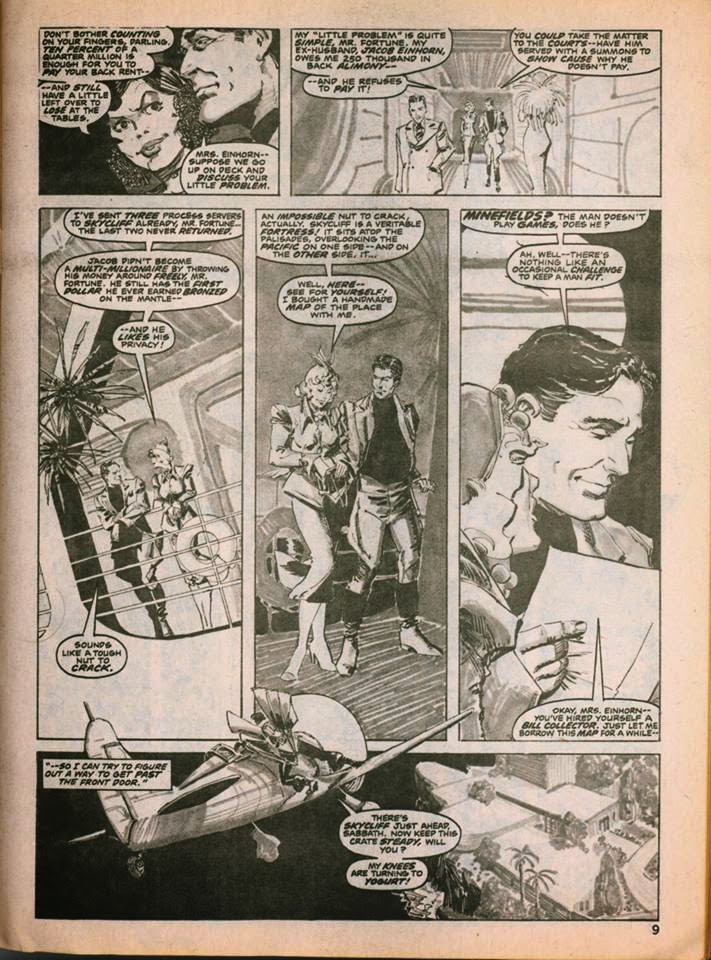
At this point, the important thing is understanding why we liked Chaykin's art. Prior to our hiring Chaykin, he had done Star Reach #1 Cody Starbuck and the ill-fated Atlas/Seaboard's Scorpion #1. Scorpion was later reworked into Marvel's Dominic Fortune. In my start of this article, I discussed Howard's work, and why we thought it worked with Ralph McQuarrie's.


These are the first panels of Chaykin's Cody Starbucks which he drew and inked. You can see his work has a lot of dynamic movement.

I don't have a scan of the Atlas/Seaboard Scorpion, so I'll post a few pages from Dominic Fortune. Though Dominic Fortune was done later than the original Scorpion, the artwork was done in the same style. Again, think of Ralph McQuarrie as you look at these Chaykin pages.


Chaykin's signature handling of action and panels. What was most impressive was his clean lines and use of action transcending panels.


CONTINUATION OF MEETING

[At the July 27, 76 meeting, there are a stack of comic books including the Atlas/Seaboard SCORPION and Star Reach 1, 4 and 5 which George looks at. Star Reach 5 is Howard's later work, which George refers to as liking less than the earlier work.]

Charlie: I brought a whole stack of STAR REACH. I gave it to him to see.

Howard: [Re #1] It won't be quite that simple, because Roy doesn't go for that approach.

[George picks up other work and begins to browse through it.]

George: Yeah, I actually liked the earlier. Something -- THE SCORPION and this style. I like that. Which period is that?

Howard: About two years ago.

George: This is very similar to around the same thing as CODY I liked a lot.

Howard: Basically, my reason for working in a simple style was to prove to myself that I could do it. Now I know that I can do it. [But] it's not commercial for people like Marvel. It's a really non-Marvel approach.


Charlie: Alex [Toth] talked about you. Did you see him?

Howard: No, I'm afraid not. He's a little bit of a (garbled). We've had some disagreements. We fight. We don't talk. He's a strange dude. He hangs up on people. He doesn't talk to people for months. I really don't like him, but how do you deal with it?

[turns to talk to George]

Howard: I'll do it in a fairly illustrative style and we'll see how the first one runs. I still want to keep it very simple, because the introduction of more is just going to go [to] shit. More and more we add is just going to go shitty. You're going to have to bold it up a little bit, just because the fine line just isn't re­producing.

I couldn't bring any of the SOLOMON KANE out with me, which I'm working on now. I'm going to finish that up as soon as I get back. That's with ink and oil. That was inked with pen, and brushed by Pentel. I will probably do it with these new Pentels which are very fine, which get pen and pen line effect, simply because it's easier for me to work that way. I can get an elaborate effect or as simple effect as I want. That's not the problem. I'm never happy with the results of my jobs in pen -- they're too scratchy. I haven't got the hand control to get like the flexibility that Simonson does, or [Bernie] Wrightson does. Well, Wrightson is meeting his deadline now, but there's so many [he missed]. That's why Wrightson's not working in color comics any more, or comics in general. His stuff's unreproduceable now.

Charlie: Is that what happened to Walt Simonson, too?

Howard: Simonson's still in comics. He got practical. He's not inking anymore, he's just laying out. He dropped out of the field. He never finished a book. He owes his father an enormous amount of money. He's taking his degree in geology and he's going to spend the next year laying books out. Also, he's living with an easy job. He comes up in the world, and then he comes down again. I think he'll still be inking a [bit] and an occasional [book]. That's what I'm going to do after the STAR WARS. I'm going to finish this book and go on lay out, and maybe get out of comic books.

George: And get into what?

Howard: Illustration, maybe. Regular [crap]. I'm real tired. Technically, the field is just falling apart. They're reproducing on paper plates now. Fine lines no longer break up now -- they wiggle! The response that I get from people who read comics is really, on a general level, pretty replusive.

[PHONE rings. Meeting interrupted as GEORGE talks to JIM NELSON. CHARLIE and HOWARD continue discussing reader responsse to comics until GEORGE finishes conversation with JIM and returns]

Charlie: Are you familiar with Alex Nino's work?

Howard: He did the adaptation of Harlan's REPENT, HARLEQUIN?

Charlie: [to George] If you haven't seen it, I've got it at home.

Howard: It's gorgeous stuff.

Charlie: He did it for the special science fiction — black and white --

Howard: He did BEHOLD THE MAN.

George: Oh, the Marvel --

Charlie: Yeah.

George: Oh, then I must have seen it. I've got all of those. But I don't remember the name.

Howard: It's very ehhh. It's not really great comic stuff. His storytelling is real weak and his design is occasionally a little too far-out to read, but the basic structure of his brush line is perfect, and that's similar to what I want to try on the STAR WARS, because it's sparkly and it reproduces. So I want to stay away from fine pen. No cross-hatching. There's enough gray. The reproduction is bad enough. I'd like to go for bold effects. I'm still trying to figure out how I'm going to do the laser swords. I have no idea. I think I'll just have to get down and do it. Fuck it up a couple of times before I get it right. And it might have to be draw in by color. That's what I'll be doing.

George: That'll be great. We're looking forward to it. Our wonderful adventure in comics. We all hope. It'll be interesting to see how it goes with the movie.

Howard: Are there going to be any problems with likenesses?

George: Well, I don't know. That's another thing. How do you feel about that? Do you feel comfortable with attempting likenesses or would you rather avoid that completely?

Howard: Are any of your actors going to be [gesticulates with hands]?

George: No, no problems.

Howard: Okay, because that's come up often. In the PLANET OF THE APES adaptation we couldn't use certain faces from the film. I'm going to attempt likenesses, only a simplified likeness. I mean over a single book, I could probably do it over six issues, it's going to be a royal pain in the ass. Simply because no matter how many photographs you give me -- you could give me tons and it still wouldn't be enough because there are just so many shots of heads. So what I've basically done with the poster, and also I feel that kid who plays Luke is a little soft in the face and I'm going to harden him up a little bit. He's got a great cleft and that's fine, but he looks like sixteen, and I'm going to harden him up. It'll make him more heroic in the picture. Han Solo is perfect. He looks like I drew him. He looks my cliche mercenary hero. He looks like Starbuck. Alec Guiness is no problem. He reeks character. You could break him into a caricature. In everything else -- I will need considerable material on the hardware. I've got all the material I need on the gun, because I've got not only the photographs provided, but plenty of small arms in the world catalogues. And the guns used in the film are very familiar weapons. I mean you look at the dominant force who carries 1896 gun. I recognized the gun immediately and fell out of my chair. Seemed like that was the only reason they gave me the job. Chewbacca will be no problem. Same thing is true of Darth Vader. Darth Vader is a comic book character. He looks like a comic book character -- Doctor Doom. I need plenty of material on the X-fighters and the Y-fighters, much more than I have now, if there is any available. Period.

Charlie: I've got color prints of the models, of the x-wing and the y-wing.

Howard: I'll need profiles on that stuff. That's what it is.

George: I think also, when they took their stuff, the problem with what they did is it's very square-on. They didn't do any --

Charlie: The model shots?

George: Yeah. They didn't do any good angles. When he did it, he drew them all at great cockeyed angles, but he didn't... When they took their stills they're all like planned.

Howard: Well, that's okay. That's no problem. I can do that in my head. My profile books never give you shots that mount or that record a view. They give you right-on or front and back of them.

George: Well, they have that -- a complete set of --

Charlie: Yeah, they have shot all the weapons and everything.

Howard: Yeah, I've got the weapons, but I need the aircraft. And I need the interiors on Death Star. I have absolutely no idea what it looks like.

Charlie: That's a problem. There are not good shots --

George: Well, you can see it. Too bad. I wish I had that book. I just assumed that you'd have lots of stills laying around like we did there.

Charlie: Well, we have a box of stills, but it's only limited up to a certain point.

George: In this book -- we've got a book. Maybe I'll send it to you. It has the story in fifty stills.

[NOTE The "Glory Book," as the photo book is now referred to by fans, given to HOWARD has a plain cover. When Roy Thomas and and Howard took on the job, they were mailed a Script, package of Ralph McQuarrie's drawings and production stills]


George: In this book -- we've got a book. Maybe I'll send it to you. It has the story in fifty stills.

Howard: Oh, with the laser sword wrapped around it?

George: No, it's like that only it's an 8"X10", only it's got fifty stills from the actual picture.

Howard: Can you take a new order?

George: Yeah.

[George steps our and arranges for Carol to find a copy of the Glory Book.]

Howard: Fine. That would help me to key. I could then take my stills and kind of piece it together. Each still from the fifty, with the others from my collection.

Charlie: Do you want all those proof sheets?

Howard: The ones you've got out there? Ah, not really. There's almost too much material there to use, you know what I mean?

Charlie: What would be better, then, is if you went through it -- which is going to take you a while -- and mark what you want.

Howard: I may have time tomorrow. Is tomorrow all right?

Charlie: Yeah, it's all right with me. It's too bad 'cause I just put in an order last night at 11:00. But if you can do it tomorrow, fine. I'll just put them to work on it.

Howard: I'll need the interior cockpit shots and stuff like that. Also some color guide. My first vision of the color film was here. I had no idea what color Han Solo -- his outfit, his hair; the Princess; I suspected Luke was blond, but it could have been sandy hair. Various things like that, my only key was the paintings.

Charlie: Why don't you come in here early tomorrow? Because you can go through the black and white, and mark out the numbers that you want. And the color -- go through the transparencies, what's here, and then mark out what you need and I'll duplicate it and send it out.

Howard: Not transparencies.

Charlie: It's the only way.

Howard: Don't you have any prints?

Charlie: It'd be better to use transparencies and just project them, because if we try to get prints it may not be very good.

Howard: I thought you were talking about the contact sheets.

Charlie: No, but we're talking about color.

Howard: Oh, those. I don't even need those.

Charlie: But if you wanted to see what the color was like, that's what I'm saying.

Howard: That I don't need immediately, and...

Charlie: Because the black and white I'll have made up as 8Xl0s. It'll take about a month to do.

Howard: Well, I'm glad I don't have to get started yet. I just don't want to fake anything.

Charlie: But I mean, if you wanted stuff that was color-keyed --

Howard: That, again, can wait.

Charlie: See, the color on a print will not be as good

Howard: Well, I won't have to color the books. The first issue isn't due on the stands until Februrary, and that means they're due in the house in December. By December, I hope to have all the books penciled, at least, and most of them inked. I hope to have the whole bunch finished by December or January. So that's cool. So I can spend January coloring six comics. So that's no rush on that.

Charley: Where's Roy? Are you sure he knows he's supposed to be here?

Howard: [shrugs] Are you sure he knows he's supposed to be here?

Charlie: [Carol] tried to call ILM, but once again, we can't call into ILM. The phones are so screwed.

George: When did that happen?

Charlie: It started happening yesterday, I guess when you arrived. And then, I don't know... It doesn't make any sense. We've called his house -- everything. It's too bad. He must have started talking to somebody and forgot.

Howard: I'd like to get on him and have him read that script, then re-read it and break it down for me because I want to get started on the job, on the first issue. I have no intention of doing break-down myself.

Charlie: But he needs a new script. That's another reason for coming over here today. He mislaid the script I sent him.

Howard: I'm not going to break the script up for him, because that's his job. I can fight with him after he's made the decision, after I've made mine. It's going to be a lot of fun to do. There's a lot of material to work with.

Charlie: Is there anything else you're going to need, other than the black and whites, do you think?

Howard: I can get the copies of the model shots now? They're in color?

George: Are they going to out there and look at them?

Charlie: Yeah. If you want to look at footage tomorrow, we can do it in the morning.

George: Actually, if they're going out there, they can also see the models.

Howard: Also, I need head shots on all the characters, the major characters and the minor ones. I have no idea who Biggs is -- the other pilot. The general in the war room with the Princess, I don't know him.

Charlie: You'll see once you get the stuff made up and you can look at the stuff. It's very kind of story-sense. Mark out the stuff. Because then what I'll do, I'll give you the sheets tomorrow. There's caption sheets for all the photos. So you can go through the caption sheets, figure out some of them.

Howard: I'm leaving Thursday.

Charlie: I know. Then what you do is mark up the shot and when I get the shot back, I'll write the description on the back.

Howard: That's okay?

Charlie: Unless you order a thousand.

Howard: I can't really see that happening. I need ship detail, background stuff, and curio detail. There are some shots of Han Solo sitting in the cockpit seat with a headset. That kind of stuff.

Charlie: Well, that's easy enough.


George: Well, have we given Roy up for lost?

Charlie: I don't know. I don't know what to do. I'm surprised at him.

George: What time is it?

Charlie: It is five of 5:00.

George: Where is he?

Charlie: He lives nearby. He lives in that new development over here on Barham.

George: Oh, yeah, there.

Charlie: It's that direction. Look at the way the lot is.

George: Oh, right. Over there.

Howard: Heavy with the lights on. Incredibly busy city.

George: Wonderworld.

Charlie: Jean-Luc Goddard called it "The Great Garage." I guess it is. You have to have some place to stuff all these people... You're signing the backs of them.

George: Yep.

Charlie: Oh, I thought the whole thing was to sign the front.

George: This is not a very good pen.

Charlie: What kind of pen do you want?

George: Well, Pentel. I want one of the narrow guage. This is one of those funny new pens. Works great, but it doesn't work so great on the back of these.

Charlie: You want a narrow, black Pentel? There may be one here [goes to desk & gets pen]

George: The pen ran out of ink. What a dud.

[Roy arrives and Charley motions in greeting.]

Charlie: We were talking about style a little bit, the illustration work.

Roy: Yeah, the illustration work. The writing will follow the screenplay, with a few captions that we'll put in... "Suddenly," for example.

Charlie: An occasional "suddenly." There's a lot of "suddenlies" in the script.

Roy: Yeah, I know.

George: "Suddenly this," and "suddenly that."

Charlie: We put a few in the novel. We put a few in today.

George: We added one to novel. He didn't have any "suddenlies."

[Conversation between Howard and Roy indecipherable.]

George: I wanted to bring up that thing, too, now that you're here. The possibility for the editorial page we talked

Roy: The naming sometimes...

Charlie: That's why I want to bring it up, because he doesn't know .. To see how he feels. The comic book is going to be seventeen pages of artwork.

Roy: And there's one page that’s used for a letters page or whatever.

Charlie: Right. That's what I meant by the editorial page, anyhow. Gary is keen on having like a credit copy or something like that for the movie, which I don't think is necessary. I think it should be replacing the letter page in the first two issues, because they'll be out before the movie. Then we'll just have copy about the movie, which is agreeable to everybody.

George: Right. I don't think we need credits from the movie.

Charlie: And that way we don't take away pages for the story. And then, the first two letter pages would definitely be just material on the movie, because they'll come out before the movie.

George: I doubt if it's necessary even after the movie comes out to do —

Charlie: Unless we want to take up half the letters page, which is probably all we'd need anyway.

Roy: I can get it typeset into half a page and we can run a few letters in the third issue. Whatever you prefer.

Charlie: That way we keep it to seventeen pages of art so that you know consistently, six issues of seventeen pages each.

Roy: And one a whole flashback sequence, which we may need occasionally. Keep it to an absolute minimum. We can get by without them.

Howard: It isn't going to be a problem.

Roy: Sometime, too, we might make the second page -- as a suggestion, one page regularly could be like "the story so far" kind of thing. And I wondered how you would feel. Any problem with that?

George: No, that's all right.

Roy: And so we could always make the second page of the story be that, and then go on from there -- another splash over there.

George: Have you figured out at all how you're going to break it down? Have you tried at all to break it into seventeen...

Roy: No, we haven't really discussed that because Howard and I never really got together, but we will...

Howard: Before we start, we'll just figure that out first.

George: ... because I haven't the foggiest idea how it's going to work.

Howard: [to Roy] What I'd like you to do -- because I'm leaving Thursday -- is read it and give me some vague idea of how you want to do it. And call me, or drop me a line and tell me.

Roy: Oh, yeah. I will. You mean when you're back east? I get the phone tomorrow, and so forth. Well before we begin, we'll sort of figure out about where we'll be in terms of space. Yeah, I don't think it'll cause that much of a problem.

George: It's also tricky, because as a unit it starts slow and builds, so you've got to be really... The first couple of issues you're going to be really scraping to try and make something happen, or you're going to have to skip along -- merrily.

Charlie: Why? The first issue's got that whole capture.

George: Of the robots?

Charlie: No, of the capture of her -- of the ship.

George: That's right

Charlie: And by the second one you've got the robots being hunted down. You've got something in there that's built-in for a comic. I don't think there's a problem.

Howard: Even when there's nothing happening, to see...

Roy: Stuff! Yes! To be visually exciting!

Charlie: Howard, what about the sky battle at the end? How do you think we can solve that?

Roy: You mean the impersonality of the whole thing? Well, there are shots in the cockpit...

Howard: Well, by constant dubbing inset panels, cutting back to head shots, the way you do it in a film. I mean, like going for -- again, that'd be a graphic problem. Inset panels, shooting back and forth. We've got plenty of room. That's the good thing, you know, there is room.

Roy: It'd be kind of strange for a comic book. I know that traditionally there is this kind of comic, you know, stories about sleek jets fighting. But in this case, it's going to be part of a continued story, and by the last issue, or two, where this is happening on this scale, they're going to be pretty well into it where we can afford an issue of that type.

George: Your basic "fighting Air Force" issue.

Roy: Something like that, yeah. A lot of big shots and insets and cutting back and forth, yes.

Howard: And the ships themselves are neat enough looking. They make nice lines.

George: Yeah, well, at least we have a variety of them and stuff like that. We're not stuck with one or two kinds of ships.

Howard: Right. That kind of stuff can get real dull real fast. As long as there are interesting designs on the ships, as you say... and a comic book isn't quite the same thing. Because the ships streaking one goes by and then after that it begins to get a little boring repeating those heads

Roy: But I think it'll work out pretty well. We started a couple of weeks ago.

Howard: You sent me something?

Roy: Yeah, it'll be back in New York by about Monday. Several pages there right now. Five or six are waiting for you.


Howard: That's what I'll do, then, next week.

Roy: And then, I'll call you next week, and we'll work out...

Howard: I'll spend my rare moments of leisure designing the calendar.

Roy: Right, of course you've the stills and you have to transfer...

Howard: Yeah, I'm going to harden certain things up and idealize others.

George: Yeah, he's going to go through and get a bunch of stills that he wants. Also we have a book that we've done which I'll send with about fifty stills in it, so that there's a vague

Howard: [cutting in] That'll help us let us see --

George: Yeah, you know, going through the story thing.

Charlie: Shouldn't be any problem.

[Marcia interjects something to Charlie who responds, indescipherable]

Marcia: [to Charlie] Have you spoken to her lately, since she's come back?

Charlie: No, I haven't phoned her since the day before she left. I've been meaning to, but [indescipherable]

Roy: There's a lot of doodads about it. A lot of action shots, sketches. People kept coming up and they were -- there was a lot of interest.

Howard: Everybody back East who had seen the collection of materials people have all gone nuts. The reaction has been incredible. Because at first it was like "come on, one more, who wants another crummy science fiction movie." Because they're all crummy science fiction movies. And when they see the material they can tell. Scientists in particular with airplanes and blowing up things, they know there's something for a start. All the guys at the studio want sets of those paintings. Even Neil.

Roy: Yeah, there's a lot of enthusiasm and I think that it should go over.

Charlie: What logo are we using?

Roy: There's a couple of good ones. But I was wondering, do you have a regular logo that will be well-known by that time or are we free to design our own if we

Charlie: We'll be in the process of designing one. I know 20th wants one.

George: Yeah, it's It's hard to know whether we should let them go ahead and do what they want, because I mean, the one we've got is essentially the company logo, which doesn't really

Roy: Is that the one like...

George: It's the one that's on the t-shirt.

Roy: I know they'd be kind of reluctant to use that. It's a little hard to read on a newsstand when a kid's looking to buy it.

Charlie: Oh, yeah.

Roy: We'd probably be best off if we made something simple -- a two-line thing. It's not THE STAR WARS? You never called it THE?

George: We used to, but we took THE off.

Roy: I thought you dropped something.

George: Yeah, we dropped it.

Roy: I think just putting those two names and perhaps there's... we ought to put a line above the title, too... kind of a lead-in.

Charlie: Oh, my God, he liked THE STAR WARS!

Roy: No, it's what you'd like to say that could be used in the movie's advertising. You know, like "Frenzy in a far-flung future," that kind of thing. You know, if there is something like that that might go well above the logo in addition, or some lead-in, something or other that ends in the words STAR WARS. Or something like that.

George: Well, we're still looking for that.

Charlie: I'd like to get that, because some people in this town still think it's the battle between stars at one studio and stars at another.

Roy: Well, I guess it could be.

George: They think it's about the Elizabeth Taylor - Richard Burton story.

Roy: There's a little confusion with using that against the War Wizards

George: Also the same studio.

Charlie: Theirs will be out before, if they're lucky.

George: Maybe.

Roy: I just wondered if you wanted to play with stuff like that, and give a call? Check if there's any problems?

Howard: Talk to Novak, maybe he'll design something.

Roy: He'd design a nice, simple...

George: The main thing we're trying to go for is the romantic angle on everything.

Howard: The Seahawk?

George: Yeah, again the thing that was right on is the Cody Starbuck Arnwold kind of thing. Romantic space.

Howard: That wasn't naughty as the one chained to one of them. What was the change of the sword? From a Samurai grip to a rapier. The impression I got from the artwork was really Samurai-outfit and the sword!

George: It is very Samurai-ish but the only problem with the poster was the style of the poster and the way it was working was it looked very Kung Fu, which is very popular, but it really read Kung Fu more than anything. And so by taking it down it sort of took away from that a liitle bit. Although in the movie, it is a very Samurai — it's much more a Samurai thing.

Howard: Well, the sword seemed too long to use as a rapier.

George: No, it is a Samurai -- You don't really see it work that often. The only thing is when Ben and Vader at the end... when they have their fight, that's the only time you see it in any kind of a fight. Hopefully, in the future, I can begin to get Luke into more of a swordsman. But there just wasn't any room in the picture utimately for it.

Roy: Particularly when the climax is the space fight.

George: Well, also with the sword thing, it got very difficult -- which it always does in a situation like that. Alec Guiness was pretty good with a sword, but the guy who played Darth Vader was terrible. Alec Guiness wasn't a swordsman, but he still could do it. And getting them to actually be good at it was really

Howard: That was the one negative reaction -- they look very silly with the swords... Fairbank's shots, even Flynn's stills, look a little silly. But Fairbanks, even the stills of him, are great.

Charlie: Oh, well, that guy was an athlete. I mean, he was just beautiful.

Roy: Well, luckily, we're not stuck with the stills. In the movie, they aren't stills, but I know what you mean.

Howard: Well, I will choreograph the swordplay.

George: The other thing is it's hard in real-life, especially if you aren't a swordsman, to actually get it to work.

Howard: That's one thing I will idealize.

Roy: It never looks as dramatic as the drawings you make of it.

Howard: We'll probably be a little bit bummed out

Roy: Looking at how it comes out on photographs.

Marcia: (garbled)

Howard: No, that one's actually a little bit larger. If you draw the proportions as they are in real-life, I mean, in the drawing his head would be larger and he looks like a child.

Roy: There's just a slight change.

Howard: Ray Morrow draws like that.

George: Yeah, they look very odd.

Marcia: Will Han Solo still be bigger in comparison?

Howard: Yes, oh, yes. Make their heads a little smaller and their hands a little bigger. I've really concentrated on Han Solo.

Marcia: I love him. He's really great.

Howard: He's the one that looks like my stuff.

George: That's why I say when I first read your stuff, you know, I was right in the middle of this, and, oh yeah, gee. And I was like every page, wow! You could really see it.

[George is informed that Mike Schultz and co. have arrived and steps out.]

Roy: Just one more minor thing... [points to letter in comic pile]... I notice that the word STARWARS and CORPORATION is listed as one word.

Charlie: No, that's a mistake. That's Ed's doing. That's Ed's letter.

Roy: Oh, because I thought it was really spelled as one word and I wanted to make sure that I had that right.

Charlie: No, it's two words.

Roy: To see Spider-man without the hyphen... it's little things that throw you off. You can spell things differently in two different places. I was just checking to make sure it was, indeed, a two worded thing. And drop the THE.

Charlie: Are there any changes now since that script, Marcia?

[George comes back into the meeting.]

Marcia: That was a short meeting. [George shakes head] Wait a minute. There must be something more important.

Roy: Well, I've talked to Charlie a couple of times, and Howard and I have talked about it.

George: And, of course, we talked about it a long time ago.

Roy: Right.

END OF TAPE